


Sun, Moon & Space Weather
Sun and moon times for Onich, the moon's phases and the seasons, and space weather: the chance of seeing the aurora from Lochaber, the Kp index and live views of the Sun.
Sun & Moon today
Sun
- Sunrise
- 08:26
- Sunset
- 15:50
- Midday (sun highest)
- 12:08
- Daylight
- 7h 24m (−3 min on yesterday)
- First light (civil dawn)
- 07:40
- Last light (civil dusk)
- 16:36
- Fully dark tonight
- 18:10 – 06:08
Moon
- Phase
- Waning gibbous moon
- Illuminated
- 82%
- Moonrise
- 20:21
- Moonset
- 12:30
- Age
- 18 days
Fully dark is the time between the end and start of astronomical twilight, when the Sun is more than 18° below the horizon. From Onich there is no full darkness from early May to mid-August.
Moon phases
Seasons 2026
Times are UK local time.
Aurora & geomagnetic activity
Tonight from Lochaber (Kp up to 3.0): Possible on camera low on the northern horizon on a dark, clear night, but unlikely by eye. A bright moon will wash out faint displays.
The Kp index (0 to 9) measures disturbance of the Earth's magnetic field over each 3 hours of UTC. From the north of Scotland, aurora often shows on camera when Kp reaches about 4 and can be seen by eye at about 5 and above, given a clear, dark sky away from lights.
NOAA 3-day space weather forecast · highest Kp expected 4.00
Geomagnetic activity
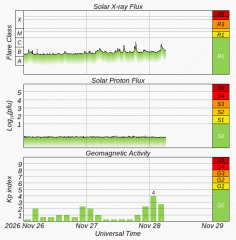
The greatest observed 3 hr Kp over the past 24 hours was 2 (below NOAA Scale levels). The greatest expected 3 hr Kp for Nov 28-Nov 30 2026 is 4.00 (below NOAA Scale levels).
NOAA Kp index breakdown Nov 28-Nov 30 2026
             Nov 28       Nov 29       Nov 30
00-03UT       4.00         2.33         1.67
03-06UT       4.00         2.67         2.00
06-09UT       3.67         3.00         1.33
09-12UT       3.00         2.00         1.33
12-15UT       2.67         1.67         1.33
15-18UT       1.67         1.67         1.33
18-21UT       1.67         1.67         0.67
21-00UT       2.00         1.67         1.67
Rationale: No G1 (Minor) or greater geomagnetic storms are expected. No significant transient or recurrent solar wind features are forecast.
Solar radiation
Solar radiation, as observed by NOAA GOES-18 over the past 24 hours, was below S-scale storm level thresholds.
Solar Radiation Storm Forecast for Nov 28-Nov 30 2026
              Nov 28  Nov 29  Nov 30
S1 or greater    1%      1%      1%
Rationale: No S1 (Minor) or greater solar radiation storms are expected. No significant active region activity favorable for radiation storm production is forecast.
Radio blackouts
No radio blackouts were observed over the past 24 hours.
Radio Blackout Forecast for Nov 28-Nov 30 2026
              Nov 28        Nov 29        Nov 30
R1-R2            1%            1%            1%
R3 or greater    1%            1%            1%
Rationale: No R1 (Minor) or greater radio blackouts are expected. No significant active region flare activity is forecast.
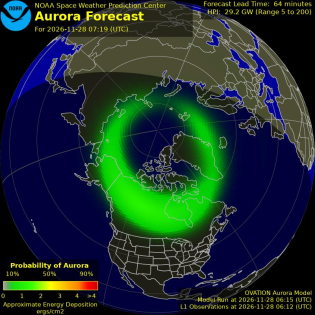
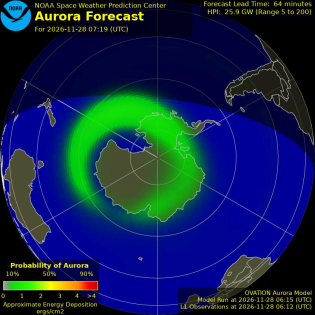
NOAA's 30-minute aurora forecast. Green to red shows the increasing chance of aurora overhead; aurora can be seen up to about 1,000 km away from the edge of the oval, low on the horizon.
The Sun now
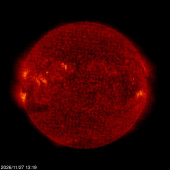
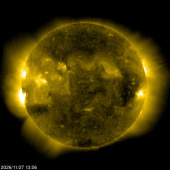
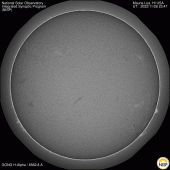
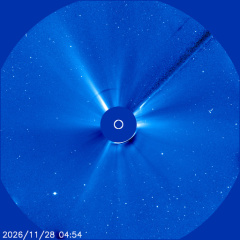
The Sun is watched constantly for sunspots and coronal mass ejections. Extreme ultraviolet images show gas at different temperatures; the hotter the gas, the higher in the Sun's atmosphere it is.
Corona & solar wind
International Space Station
Where the ISS is now, with its path over the next orbits and the day and night sides of the Earth.
HF & VHF radio conditions
Space weather links
Aurora status from AuroraWatch UK, Lancaster University. Kp index, forecasts and images courtesy of the NOAA Space Weather Prediction Center, SOHO (ESA & NASA) and the Mauna Loa Solar Observatory (HAO/NCAR). ISS map by isstracker.pl; radio conditions by HamQSL. Originally based on the Space Weather script by Mike Challis, with additions by Ken True and Jeremy Dyde.